Rainfall Review for november 2021
- March is climatologically the coolest month of the year and falls at the middle of the cool transition period of the dry season for Belize. Rainfall during the month is normally attributed to the passage of frontal systems that progresses southward from the continental United States and upper and surface troughs. Typically, an average of twelve cold fronts, two stationary fronts and one warm front would cross Belize for the month but in January 2021, an average of one front every 14 days crossed the country, with a few weak fronts passing north of the area.
- The proximity and passage of these frontal systems contributed to the month’s rainfall, especially over northern regions. This led the sampled stations to record above normal rainfall over the northern half of the country, while below normal conditions were observed in central and southern areas.
- Of the sampled stations, the highest monthly rainfall was recorded at the PGIA Station in the Central Coastal Area, with a total of 411.6mm of rainfall with 13 rain days.
- The highest one-day rainfall total of 154.4mm occurred on October 21, 2021, at the PGIA Station in the Central Coastal Area.
- The Savannah Station in the Southern Area recorded the greatest number of rain days with 17 days in total (rain day >=1mm).
- The lowest monthly rainfall was recorded at the Spanish Lookout Station in the Central Inland Area with a value of 79mm, 63 percent below its normal monthly mean of 211.4mm for the month of October.
- All the sampled stations analysed recorded rainfall amounts below their long-term averages except for PGIA which recorded rainfall amount above its long-term average. (Figure 1).
- Add new text
Standard Precipitation Index (SPI)
Standardized Precipitation Index (SPI) The Standardized Precipitation Index (SPI), developed by T.B. McKee, N.J. Doesken, and J. Kleist in 1993, is a tool used to monitor drought conditions based on precipitation. The SPI can be used to monitor conditions on a variety of time scales namely 1-month, 3-month, 6-month, 9-month and 12-month periods. This temporal flexibility allows the SPI to be useful in both short-term agricultural and long-term hydrological applications by providing early warning of drought and for making assessments on the severity of a drought. In primary agricultural regions, a 3-month SPI might be more applicable in highlighting available moisture, gives an indication of soil moisture conditions as the growing season begins and captures precipitation trends during the important reproductive and early growing stages of crop development. The National Meteorological Service (NMS) of Belize calculated the observed SPI (see Table 1) using a 3-month and 6-month time interval, respectively and classified the observed conditions using the severity classes of SPI (see Table 2).
Table 1: Observed SPI for Selected Stations across Belize during the September 2021 TO November 2021 and June 2021 TO November 2021 periods (NMS Belize).
Table 2: Severity Classes of the SPI (CIMH).
| SPI Value | Category | SPI Value | Impact |
| -0.50 to -0.01 | Normal | 0.50 to 0.01 | Normal |
| -0.80 to -0.51 | Abnormally Dry | 0.80 to 0.51 | Abnormally Wet |
| -1.30 to -0.81 | Moderately Dry | 1.30 to 0.81 | Moderately Wet |
| -1.60 to -1.31 | Severely Dry | 1.60 to 1.31 | Very Wet |
| -2.00 to -1.61 | Extremely Dry | 2.00 to 1.61 | Extremely Wet |
| -2.00 or less | Exceptionally Dry | 2.01 or more | Exceptionally Wet |
Based on the SPI figures for the November to January period, stations across the country showed exceptionally (wet) conditions at three stations, three stations with very (wet), one station with extremely (wet) conditions, one station with moderately (wet) conditions and one station with normal (wet) conditions. In the short to medium term, the wet spots were found in most areas of the country, especially in northern and southern parts of Belize, with most areas having excess available moisture that can potentially lead to flash floods. The August-January period saw 2 of 9 stations across the country experiencing extremely (wet) conditions; two stations experienced moderate (wet) conditions, two stations experienced abnormal (wet) conditions, one station with exceptionally (wet) conditions, one station with normal (wet) conditions and one station with normal (dry) conditions. The second half of the 2020 wet season observed an extremely wet trend over most areas of the country. This was due to a moderate La Nina pattern that strengthened toward the end of the season leading to a wet trend across the country. With an El Nino Southern Oscillation (La Nina) pattern forecasted to weaken and transition to more neutral conditions in the coming months, rainfall predictability remains highly uncertain and the likeliness of wet spells and well as very wet spells are expected over some areas in Belize, with high surface moisture continuing over the country through the remainder of the dry season. Therefore, based on the observed (November to January 2020) and forecasted (up to April 2021) SPI values, in the short and medium-term there is currently NO CONCERN for drought for most areas of the country. In the long term, there is also NO CONCERN for most areas and with the possibility a DROUGHT WARNING for southwest Belize.
Temperature Review for november 2021
For the month of October, maximum temperatures were above normal over Belize based on the sampled stations, with the Towerhill station recording the coolest daytime mean maximum temperature with a value of 31.2oC for the month (Figure 2).
The highest one-day maximum temperature was recorded at the Melinda Station in the Northern Area with a value of 36.5oC on October 13, 2021.
The Punta Gorda Station recorded the highest mean monthly maximum temperature with a value of 34.1 oC.
The Airport station (PGIA) recorded the highest mean monthly minimum temperature of 24.4oC.
The Central Farm Station recorded the lowest daily minimum temperature of 15.6oC on October 31, 2021.
For the month of October, the Towerhill, Central Farm and Savannah stations recorded minimum temperatures above their long-term averages, except for the Central Farm Station whose minimum temperature was below normal (Figure 3).
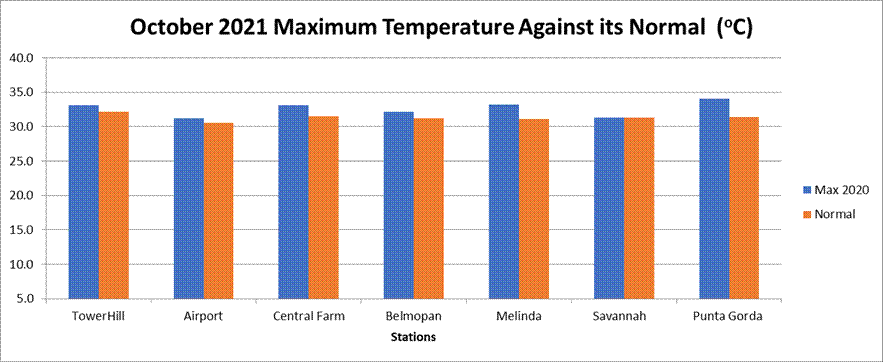
Figure 2: Comparison of the Mean Maximum Temperature and the long-term averages of selected stations for november 2021 (NMS Belize).
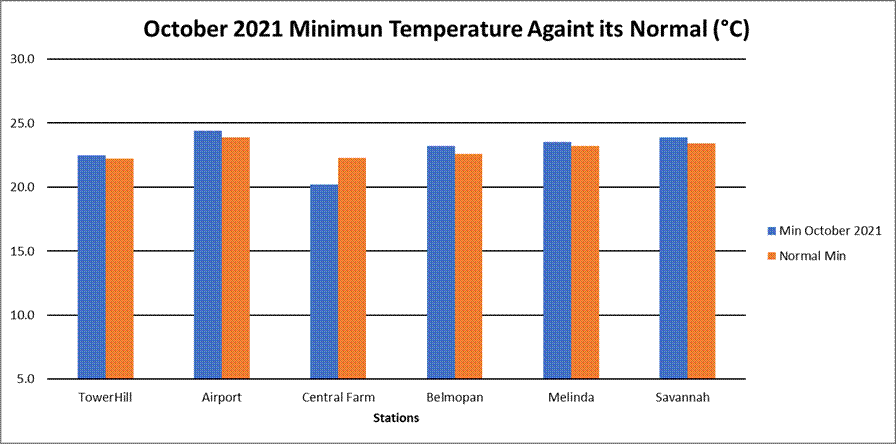
Figure 3: Comparison of the Mean Minimum Temperature and the long-term averages of selected stations for november 2021 (NMS Belize).
Possible implications of the Seasonal Outlook (November-December (2021) -january 2022) on Agriculture
Rainfall to be near normal to slightly below normal across much of the country, except for below normal rainfall over some western and southern areas during the period February – April 2021 (FMA 2021)
Maximum/daytime temperatures are expected to be slightly warmer than usual while minimum/night-time temperatures will be near normal.
Rainfall for agriculture continues to be unreliable due to high uncertainty in the El Niño southern oscillation (ENSO) predictions for the coming months, currently in a moderate La Niña phase and is one of the most important climate drivers that affect our rainfall.
An increase in surface wetness and soil moisture expected.
High probability of at least three 7-day dry spells.
An increase in the frequency of wet spells is also expected over FMA, so there is limited to moderate flood potential.
The increase of pest and diseases associated with moist conditions is likely.
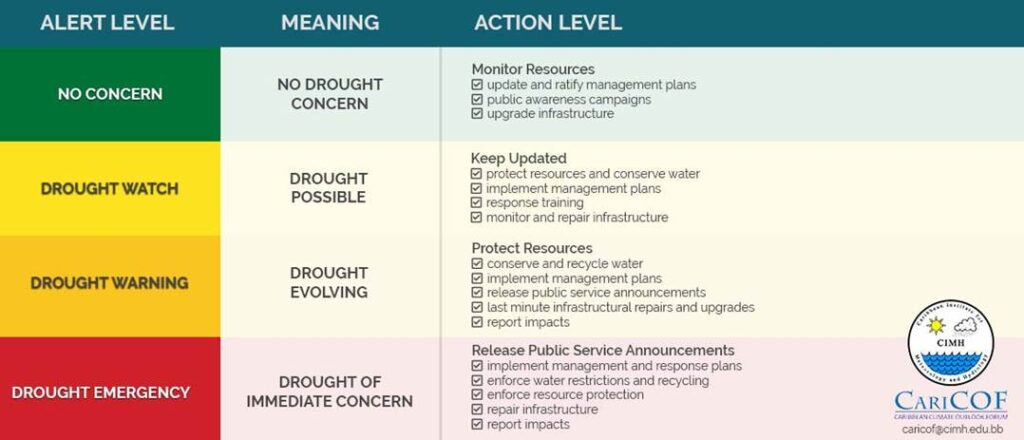
Short term drought is not expected to develop by the end of April 2021, so there is currently NO CONCERN for drought in the short to medium term across most of the country.
The long-term outlook suggests that drought is possible in the southwest Belize, so a DROUGHT WARNING is in effect, while NO CONCERN for drought exists for the remainder of the country through to the end of May 2021.
Advice to Livestock Farmers:
- Monitor livestock for pests and diseases associated with wetter conditions.
- Provide proper shelter for animals in warm and dry conditions.
- Construct water troughs- where possible to provide water for livestock during dry periods.
- Continue to monitor and conserve water and preserve resources, especially in the central zones and southern zones.
- Implement drought management plans if drought begins to develop in areas where a drought warning is issued.
- With a forecast for above-normal daytime and night-time temperatures and drier conditions, there is the possibility of increased heat stress for livestock and other animals, therefore, cooling, shelter and hydration provisions are being recommended.
- Find alternative feeding mechanisms for livestock.